Nowhere to Live: The Truth Behind Britain's Rental Crisis
Rents have risen 34% in four years. 130,000 households are in temporary accommodation. And 93,000 landlords left the market last year. This piece breaks down who is paying the price for Britain's rental crisis and why.
Renting in Britain
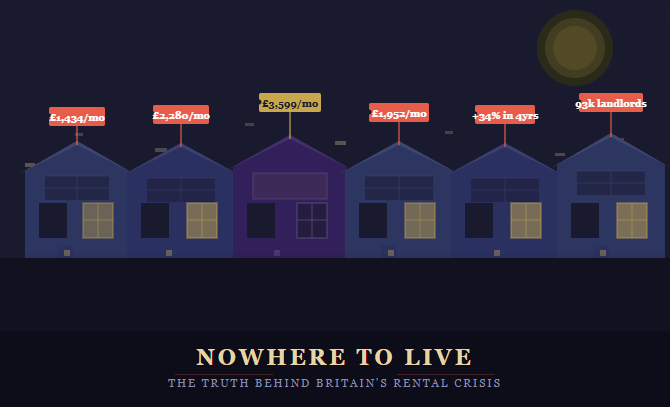
Let's put it simply. Renting in Britain right now is brutal. Not inconvenient. Not a bit pricey. Brutal. According to the ONS, the average private rent in England hit £1,434 a month in March 2026. In London, that average is £2,280. In Kensington and Chelsea, it's £3,599 a month. The North East, known for being the cheaper area to live in the UK, rent prices are rising faster than anywhere else in the country. No one, and no where can escape the claws of this issue.
Half Your Wages Gone
More than half of UK renters are spending 40% to 50% of their income on rent. Not the third that is recommended to ensure financial security. Spare Room's data shows that flat sharing, is now only affordable if you earn at least £30,120 a year. A giant figure to split a flat with a stranger.
Between April and October 2024, just 2.5% of private rentals listed in England were affordable under Local Housing Allowance rates. This excludes a huge number of people on benefits.
Where Have All the Homes Gone?
The supply and availability of rental properties are far from sufficient. There are not enough homes. Zoopla's March 2026 report puts supply at 23% below pre-pandemic levels. Rightmove goes further where the total number of homes available to rent is 33% lower than it was a decade ago. This is a sustained collapse in supply spanning years.
The reason is not complicated. Landlords are leaving, and leaving fast. Around 93,000 buy-to-let landlords exited the market in 2025 alone, up from 65,000 the year before. 31% of landlords still in the market are planning to reduce their portfolios, and 16% intend to sell everything within two years.
When a landlord sells, that home almost never goes back into the rental market. 15.6% of all new property sale listings were previously rented homes. Just 2.9% of them were re-let afterwards. The rest were gone. Bought up, sat on, or sold to owners. Landlord sales are now the single biggest cause of tenancy endings in the country.
So people are losing their homes, not because they did anything wrong, but because their landlord decided to cash out.
What Happens Next?
This is where the story stops being about numbers and becomes about real life. A lived experience that is a tragedy. At the end of the 2024 to 2025 financial year, 130,890 households in England were living in temporary accommodation, an 11.5% rise on the year before. Of those, 83,150 had children. Rough sleeping also rose by 20% in a single year. Local councils spent £3.8 billion on homelessness in that financial year. That is more than double what was spent in 2009 to 2010. The money is being spent reacting to the crisis, not preventing it.
There are 1.34 million households on social housing waiting lists in England right now. And the private rented sector, the thing that was never supposed to be a safety net, now houses around a fifth of all households in the country. This comes at a high cost.
This Did Not Have to Happen
Social housing made up about 20% of England's housing stock in 2000. By 2023, that had fallen to around 16%. The homes sold off under Right to Buy were not replaced. That gap got filled by private landlords charging market rates, and now those landlords are leaving too. Rents rose 34% in the four years after the pandemic. They have slowed now, but slow growth is not the same as affordable. It just means that the pace has slowed, the damage is already done,
This is the result of decades of decisions. Decisions to sell social housing and not replace it. Decisions to freeze housing benefit. Decisions to do nothing meaningful about supply. None of it was inevitable. All of it was chosen. And the people paying for those choices are not the ones who made them.
Sources
ONS — Private Rent and House Prices, UK: February 2026 — ons.gov.uk/economy/inflationandpriceindices/bulletins/privaterentandhousepricesuk/february2026
Big Issue — Why are rents so high and will they keep going up in 2026? — bigissue.com
Zoopla — Rental Market Report: March 2026 — zoopla.co.uk/discover/property-news/rental-market-report
Rightmove — UK Rents Expected to Rise 2% in 2026 — via Yahoo Finance, January 2026
SpareRoom — Annual Rental Market Summary 2025 — spareroom.co.uk/content/info-statistics/annual-rental-market-summary-2025
Crisis & Health Equals — cited in Joseph Rowntree Foundation, Under Pressure: The Affordability Challenges Facing Private Renters — jrf.org.uk
Ministry of Housing, Communities and Local Government — Statutory Homelessness in England: Financial Year 2024–25 — gov.uk
Ministry of Housing, Communities and Local Government — Statutory Homelessness in England: January to March 2025 — gov.uk
Ministry of Housing, Communities and Local Government — English Private Landlord Survey 2024 — gov.uk
Shelter — cited in Homelessness Monitor 2025, via Shelter England — england.shelter.org.uk
Crisis — Homelessness Monitor: England 2025 — crisis.org.uk
Institute for Government — Performance Tracker 2025: Homelessness — instituteforgovernment.org.uk
Gov.uk — Social Housing Lettings in England, April 2024 to March 2025 — gov.uk
Alto / Homenicom — The UK Landlord Exodus: 93,000 Left in 2025 — homenicom.co.uk
LandlordZone — Why More UK Landlords Are Leaving Homes Empty or Selling Up — landlordzone.co.uk, January 2026
August App — Why Are Private Landlords Quitting? Landlord Exodus Explained 2026 — augustapp.com
TwentyEA / TwentyCi — cited in LandlordZone and August App, 2025
Savills — cited in Lakin & Co, Billions Wiped from the UK Rental Market — lakinandco.com, March 2026
UK Mortgage Centre — The UK Housing Crisis Explained (2026) — ukmc.co.uk